Case 04 · AI / Accessibility
Sema
An offline interpreter for Kenyan Sign Language
- iOS
- ON-DEVICE
- HACKATHON
Opening · Sema
The goal isn't to showcase the model — it's to make communication possible when the network isn't there.
The idea
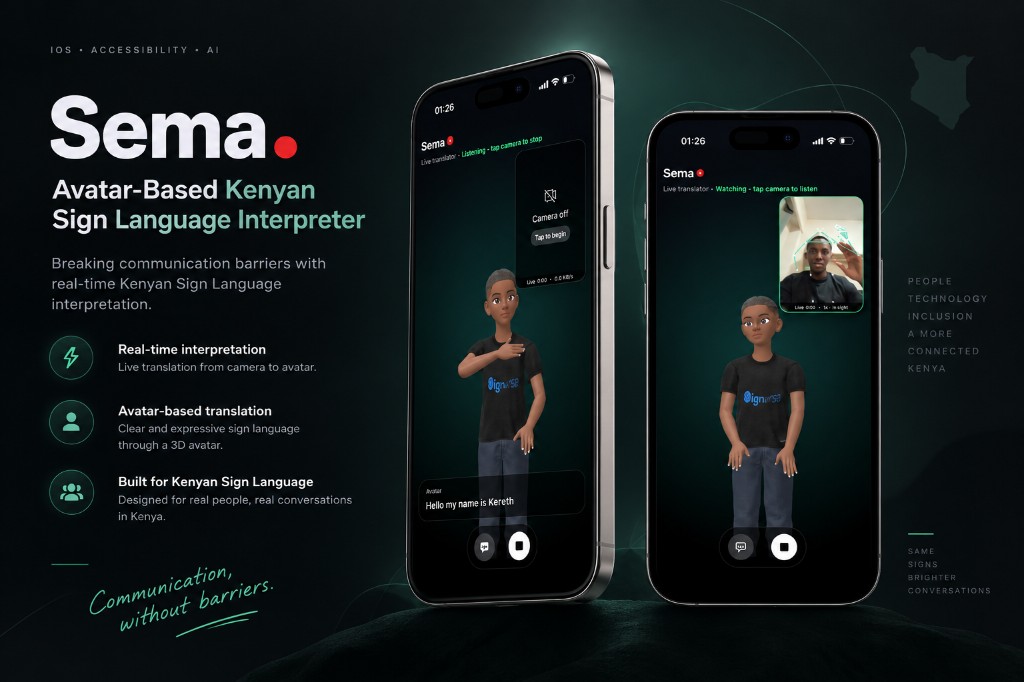
Sema was built during the Gemma for Good Hackathon by Google DeepMind, where we wanted to explore how on-device AI could solve a problem where an internet connection shouldn't be a requirement. The idea was to build an offline interpreter for Kenyan Sign Language (KSL) that could help people communicate more naturally in real time.
The concept was simple: point the camera at someone signing, let the app understand the signs, and turn them into spoken or written language. Because everything needed to work offline, we explored running the intelligence directly on the device instead of sending conversations to a cloud service.
The build
The interesting part was making that interaction feel like a conversation rather than a translation tool. The app was designed around real-time communication, with the goal of reducing the friction between signing and speaking without requiring an internet connection.
I worked on the core application and the on-device AI architecture, bringing together the KSL recognition pipeline, local Gemma inference, and the real-time interaction layer.
What I learned
Sema became our experiment in how far you can take a small, local AI system when the goal isn't to showcase the model — it's to make communication possible when the network isn't there.
- Gemma 4
- llama.cpp
- MediaPipe
- SwiftUI