Case 02 · AI / Conservation
Coralyst
Listening for blast fishing — locally, from a real reef problem
- MACOS
- CORE ML
- FIELD
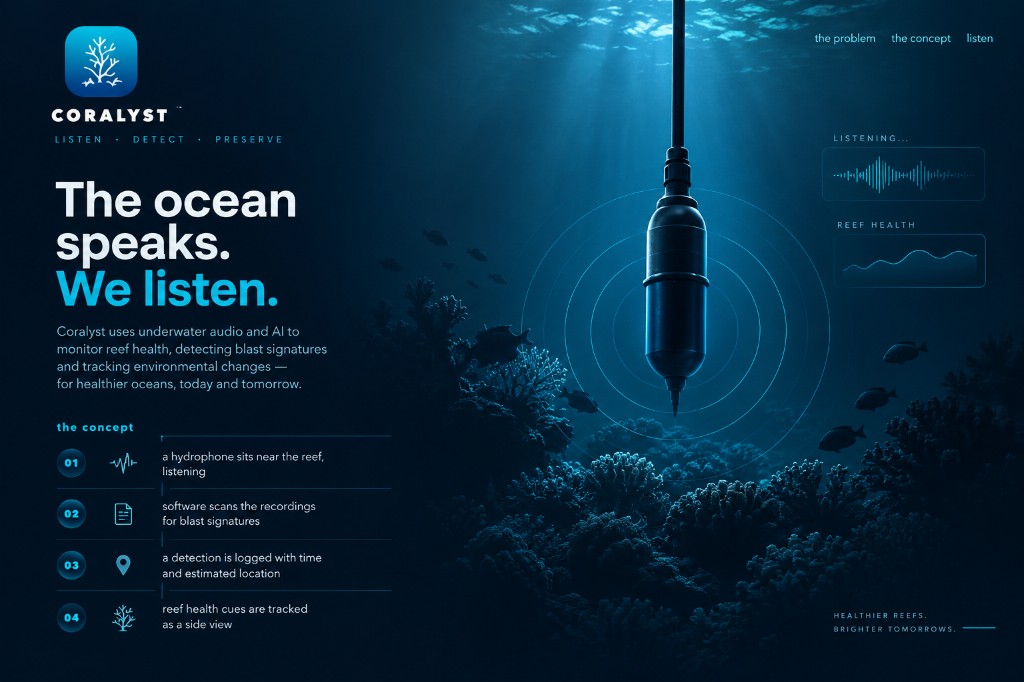
Opening · Coralyst
Illegal blast fishing can destroy a reef in seconds, and the explosion leaves a distinct acoustic signature underwater.
The idea
Coralyst started as a community challenge at the Apple Developer Academy. We partnered with Biorock Indonesia, a community working on coral reef preservation, and spoke with marine biologists and people from organizations across different countries to understand where technology could actually help.
One problem stood out: illegal blast fishing can destroy a reef in seconds, and the explosion leaves a distinct acoustic signature underwater. We wondered if we could teach a computer to recognise it. We started with publicly available research, including work by Ben Williams, and built our own approach around the data we could access.
The build
The data was limited, which meant we couldn't simply rely on a huge training set to make the model work. I had to be much more deliberate about how we prepared the audio, trained the model, and evaluated it. That constraint became part of the engineering challenge rather than a reason to stop.
I designed and built the AI pipeline end to end — from the audio data and model training to the architecture for running inference locally. I then brought it into a native macOS app, so the computer could analyse underwater recordings without sending them to a cloud service.
What I learned
What started with conversations with people protecting coral reefs turned into a working prototype that could listen for one of the sounds threatening them. Coralyst taught me how much more interesting building becomes when you start with a real-world problem and have to work within the constraints of reality.
- Python
- Core ML
- Swift
- macOS
- AVFoundation